Tuesday, April 8, 2008

I finally have photos to aid me in my attempt to describe the undescribeable - the insane Thingyan holiday, aka “the water festival” in Myanmar.
First a little background:
Thingyan is the name of the Burmese new year holiday.
It’s celebrated over the course of 5 days in April according to the Buddhist calendar.
It’s the most important public holiday in Myanmar.
It coincides with the both the peak of the dry/hot season and the beginning of kiddies summer vacation from school.
In the past, it was a traditional part of the festival to sprinkle water into a silver bowl, to metaphorically “wash away ones sins” before the beginning of the new year. This has morphed into an all out water fight involving buckets, hoses, and water guns that persists through all 5 days, hence the modern name “Water festival”.
For more info, check out the Thingyan wikipedia entry.
Now some more specifics about the “water” part. Here are a few typical street scenes during the festival. This is what it looked like everywhere in Yangon and Mandalay over the five days of the festival:

Everywhere, and i mean EVERYWHERE, there are people in the street with the buckets and hoses just waiting for someone to walk or drive by. From my observations, no one is exempt except for monks. Women, young children, the elderly, a car with a window rolled down, everyone gets a bucket of water poured on them if they are out in public. Foreigners are especially popular to douse. It appeared to me that anyone who spots a foreigner coming informs everyone else nearby so they can have their water spraying implement ready and/or begin an active pursuit of the targets. There are no exceptions, for example, if you’re holding a camera, which made it challenging to get photos of the action!
Clustered around town are sponsored “hose stations”; a stage facing the street with a dozens of hoses for partakers to use:
Lots of folks, especially teenagers and young adults, pile into trucks and jeeps and drive slowly around town getting repeatedly soaked with water and throwing their own buckets at random people they pass . In the areas with high concentrations of hose stations there are also crowds of people dancing in the street amidst the spraying water.


Thursday, April 3, 2008

I don't know !

I was working on my final project as usual; meeting Burmese new comers, asking about their experiences in life and so on. All the stories that they told me are similiar to this ( below ) story. I got this from one of my friends. I hope, this story will give you a " thought " on your mind. i don't know what kind of thoughts it will give you. But i am sure after reading this, something will come across on your mind.


Bangkok is a notorious destination for sex tourism.But the lives of many of the city's sex workers are full of danger, disease and the urgent need to send money home.Pim, who recently left her job in a go-go bar, has a typical story.
"I grew up in the countryside. My parents were farmers and I helped them in the fields. We were poor but we always had enough to get by.When I was about 15, my family fell apart. My father always drank a lot, but it became worse and worse, and he started becoming violent. So my mother, sister and I moved out.I wanted to study to become a nurse, but when my parents split up I had to leave school and find work as a day labourer, harvesting crops for local farmers. I didn't like it much, and it only paid 100 baht ($3) a day.At about that time a good friend moved to Bangkok, and when she came back to visit she told me she was earning a lot of money there as a waitress.
There was gossip in the village that she was doing something other than waitressing, as she was sending 10,000 baht ($300) home a month, but she always denied it.She asked me to come with her, but at the time I was still 16 and too scared. A few years later, though - when I had given birth to my daughter, and my husband and I had separated - I changed my mind.I left the baby with my mother, and told her I needed to earn some money in Bangkok. But I didn't tell her what I was doing - I still haven't. She'd be so ashamed.
'Can I do this?'When my friend took me to a bar in Nana Plaza for the first time, I was really shocked. I'd never been to a place like that before, and at the beginning I didn't even know what the dancers were doing.When I finally realized, I couldn't take it and I walked out of the bar. I kept thinking 'Can I really do this?'Initially I decided to work there just serving drinks, but the dancers earned a lot more money, and eventually I agreed to do that too.For the first month, the bar owners allow girls to get their full salary even if they just work as dancers. But after that you have to meet a quota of at least 10 customers a month, or your wages will be cut.
My first customer was a Western man in his 30s. It was scary and I really didn't like it, but I just kept thinking about the money.I couldn't wait for him to leave, and when he did I had a shower for a very long time. I started crying, and thought about what my parents would think if they knew what I was doing.None of my customers ever asked me about my life; they didn't care. There was one time a guy asked me if I was okay, but I didn't know what to say, so I just looked away.While I was working in the bars, I was often worried about disease, and also about safety. Some girls earned extra by going out of the bars with the men, but I always used a room upstairs as I was too scared of the risks involved.My friend once went with a guy to his hotel room, and found lots of other men there too. She wouldn't tell me what happened after that, but she was shaking for a long time when she got back home.I also had some scary experiences myself. One time a Japanese man followed me all the way home at the end of the night, and he kept screaming at me.Taxi drivers can also be threatening to bar girls, and we would only dare go home in groups.
Looking forwardDespite these problems, new girls often arrive. Many customers prefer children or young girls, and the bar owners always encouraged us to recruit teenagers from our home villages.Even though I got used to it in some ways, I always hated working in the bars. I made some good friends but there was nothing good about the life I was leading.
I felt good about sending money home, but I didn't feel good about myself. Soon I was getting penalized as I wasn't getting enough customers.
That's when a friend of mine told me about Nightlight [a Christian charity offering training and employment for former sex workers, through a jewellery-making business].Since I've started working there, my life is so much better. I don't earn as much as I did in the bars, but it's worth it, and people here listen to me and care for me.I've now got the opportunity to look forward in life. I want to finish school, and study accounting, so I'll be able to pay for my daughter to have a good life.I wish I had never become a sex worker. I think some foreign men think it's okay to pay for sex here in Thailand, as they think the girls actually want to do this.But these men don't understand that most of us have no choice - we're just trying to earn money for our families, and waiting for a chance to leave."

Tuesday, March 25, 2008


According to scholars, In Burma there is a three day New Year festival called Maha Thingyan, which is celebrated with prayers, fasting and fun. During the festivities, buildings and temples are washed, and people throw water over each other. This is partly to welcome the heavy rains of the coming monsoon season.
The Burmese New Year festival is held to celebrate the New Year, by performing meritorious deeds and spraying one another with Thingyan water.
The Burmese New Year, which is based on the Fixed Zodiac system, falls on or around April 16. Thingyan means change. Cula thingyan (or small change) occurs every month. Maha thingyan (or big change) occurs once a year. The Burmese consider it to occur in Meiktha on or around April 13 and lasting three or four days.
Thingyan is the traditional Burmese New Year's festival. It lasts for three days and during that time everyone must get wet in order to welcome in the New Year. The Burmese believe that water acts as a soul purifier. Getting wet means that one can start the New Year with a cleansed soul.
let me tell you about “Burmese family”. Family is important in Burmese culture. While I was at the festival, I saw young people being disobedient to their parents. I was so hurt by seeing these people because I know what a family means. I know that those parents are hurt by the ways their children are treating to them. But they can not show their feelings openly because “they are in the United States”. The family is very important in my family as well. But at the festival, most young people who were born here or grwon up here have hard tim followingt the traditions of the family. I am not saying that only parents have hard time teaching their children about Burrmese traditions and values. But aslo, the children also have the hard time to obey them. I know that they want to do what their parents did to their grandparents. The problem is the children spend so little time with their parents. If father works first shift then the mother works second shift. The children have school at 8:00 in the morning. So, where is the time for the parents to sit down and teach the value ? Most of them don’t have the time. The children have to spend all day with their classmates and neighbors who I am sure are American. So, everyday they are learing American culture and what American people call “ Freedom”. But a the festival, the families seem to put their very best afford to their children because I saw their children dressed in Burmese cloth and talking politely to their parents and other people.
Burmese people are very sensitive and very fragile. They are easy to love other person and hard to hate other person. At the festival, I saw everything that I am supposed to see. As an outsider and as an insider, there is one thing I might say is that Burmese people have beautiful traditions and beautiful beliefs. And I believe wherever they are, they will still be the same and follow their traditions and customs. Anyhow, by conclusion, even though those people have their values, customs and their own Burmese culture, they try their best to express what Burmese celebration look like in a foreign country. They try their best to bring the Burmese traditions and culture to American community with a hope that one day, American people and community will recognize Burmese as people with the golden culture and golden traditions.

Tuesday, March 18, 2008

New Year~

I will continue talking about Burmese Culture since Burmese New Year festival is not far. We are going to celebrate Burmese New Year festival ( water festival ) in April 6 around 4:00 pm at Sunset Hall. I recalled my memory from last year water festival. I had a wonderful time at the festival. I remembered about writing a paper about water festival last year. In order to write this blog entry, I had to go through my paper from last two semesters.
First of all, let me start with beliefs and values that Burmese people in Fort Wayne still maintain. It might sound ridiculous for you but it is very true. Before the ceremony begins the whole committee inclding all the elders, dancers and other participants gatehr together to pray for the ceremony. What we do is we sit in vertical line putting elders a front. The reason why we put elders a front is we believe that the elders that more experiences in life and we value their being here with us. After we line up, one of the elder starts to pray in Burmese for the good time and for no distruction from evil spirits. The prayer takes about 20 to 30 minutes. After the prayer, one of the prayer announces that the ceremony is in section, then the dancers come up and start dancing. They try to do the ceremony to be authentic according to Burmese style. As an outsider I might say that the prayer seems very beautiful and very cute it does not matter I believe in that or not. The custom that prays in Burmese before the ceremony is very pleasant to see to the outsiders and I heard some American people saying what a nice custom is ; putting the elders a front.
At the festival I saw many dances. Among those dances, I was surprised to see the folklore dance. Because folklore dance is very hard to dance because it takes time to practice and requires lots of hard works such as settings and people. But people in Fort Wayne presented the folklore dance at the festival as one of the prides of Burma.
There is one thing that I discovered as an outsider is the cloth that they wear. At the festival, most elder people wore Myanmar Longyi. I was happy to see people wearing Longyi because it shows that they still do not forget their cloth. In Burma, we have our own traditonal cloth. Most people in Burma still wear it. The “ Longyi ” looks like a sarong in India is worn by both male and female. The longyi represented the Burma and you can see the Longyi in Burmese money as one of the prouds of Burma. At the festial, I did not see a lot of men wearing longyi but I saw most of the elder women wore longyi. So, I asked why she is wearing longyi in the foreign country. She said “ I like longyi anyway. I do not like wearing skirt or pants. They make me uncomfortable. Once you got a stain on the back of your pants you can’t do anything about it beside change the pant. But with the longy you can put the stain inside and wore it like a sarong in India. Also, I want to show the American people our traditional dress. ”. Form that answer, you can see why she is proud of wearing the longyi and how much she enjoyed to wear it. I am very proud of her as an insider and very impressed by her speech as an outsider.

Tuesday, March 4, 2008

A true Spirit of the water-festival

Every nation of the world has designated its New Year day in accordance with its custom and tradition. Burmese New Year water throwing festival is going to be in April in Fort Wayne. The reason why the New Year is in April is that there are three seasons in Burma; rainy, summer and winter. According to Burmese calendar, March to May is summer season. Summer in Burma is very hot and humid. Sometimes, the degree goes up to over 100. That’s one of the reasons why the New Year festival is in April. What we do at the festival is we splash water to each other meaning to wash away the old year’s dirt and welcoming the new year with the refreshing water and wishing to be cool and in peace as water makes you cool down. But in Fort Wayne, you could still see the snow in April sometimes. There are 3000 Burmese people in Fort Wayne. They still hold onto their traditions and their customs. Nothing grand compared to the celebration back home but I dare say that it's the grandest THINGYAN (Water Festival) in any other countries outside our homeland.
According to the proofs and references, this sort of water festival has been celebrated in Myanmar since 500 years ago.

Layers of Culture

There are twelve months in Burmese calendar and twelve festivals in each months. Among those festival, the most well-known festival is Thingyan ( New Year’s celebration ). Thingyan festival lasts four days long. We celebrate Thingyan; water throwing festival in April. Before we proceed with the rest of the paper, there is something we should know about Burmese culture. Burmese culture is traditionally family and religion-oriented. As you know, Burma is Buddhist country and 97% of Burmese people are Buddhism. Burma got influences from the neighbor countries such as China and India where Buddhist stands in major category in their lives. Burmese culture is very unique because of its own traditions and values. In Burmese culture, we have the saying “ a-nah-dah ”. It means that a tendency of feeling hesitate towards other person. For example- I go to a house to visit. When I got there I saw that they are eating their lunch or so. As soon as they saw me coming in, the first words they say is “ come and eat with us ”. I said “ No, thank you” even though I am very hungry from my trip. The reason why I said No is because I feel “a-nah-dah”. If I say “ yes, I will eat ” then you have to get up and get a plate for me. If they have been eating with random dish, you have cook new dish for me because I am a guest. Burmese people care so much about their guests. They want their guests to be very satisfied with the hospitability. In American culture, if you want to eat then grab a plate, come and sit with us and eat what we eat. Unlike American culture, Burmese people will not let their guests eat what the host eats. The host wants to cook their best for their guests. Burmese hosts want the reputation of being a good host by giving the best of their food and the best services.
Thinking about American and Burmese culture, I realize one thing that is common between the two cultures is that each country has own culturally diverse in its own way. Needless to say America has a variety of nationalities, immigrants, scholars, and business people from different countries. Burma, on the other hand, is has in terms of its various tribes or ethnic groups, which possess their own distinct cultures within the country. Since Burma is composed of over 135 ethnic minorities, including the eight major ethnic groups, describing the culture is not easy.

Tuesday, February 26, 2008


So what is a Korean? Silly question in a way, isn't it. Though my judgement might be uncertain on individuals, I'm pretty sure that I could distinguish on sight between a group of 50 Koreans and 50 Chinese. That is quite apart from the mannerisms, the social preferences, the food, and of course the language. Korea, we are often told, is a "monoculture" and a distinctive "race"; (Japanese have a similar story). But just what does that mean? I still don’t know what it means. Anyway, I don’t feel like to continue to write about it. I saved this four or five lines about korea on my disk and went to sleep.

The next day:

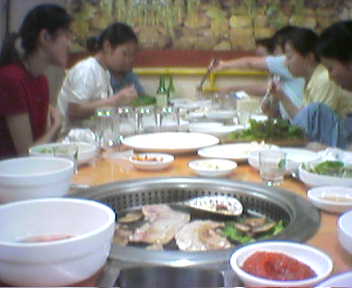
I tried to recall my memories in korea by looking at my pictures with my friends. All of a sudden, I felt like I went to eat korean food. So, I made a phone call to my sister ( studying at IPFW )and went out to eat. We went to the korean resturant ( Tokyo & Seoul) in west jefferson. Tell you the truth, that resturant is pretty expensive. I chose that resturant coz I went to eat Sam-gyab-saal. I loved to eat Sam-gyab-saal when I was in korea. I used to eat it three or four times a week.
Sam·gyab·saal

Korean meal consisting of chiefly pork, accompanied with various side dishes like bu·chim·gae, lettuce leaves, native grass and herbs, onions soaked in vinegar, roasted cocoons, fried eggs, and a hundred other things that you wouldn't even want to know. And ofcourse, So·ju ( korean beer)Tranlated literally, Sam·gyab·saal means three fold flesh. This meal is usually served at special occasions like welcome parties, farewell parties, homecoming parties, birthday parties, graduation parties, thesis defence parties, and any other goddamn reason that you can think of. Infact other than drinking beer, this is the only way that Koreans celebrate. The table is very low and everyone sits on small cushions on the floor around it. The table, typically crowded with more than fifty bowls, has a charcoal stove in the center over which the aju·ma places a metallic plate. Everyone gets a bowl filled with native grass & weed seasoned with exotic spices. The charcoal stove is used to barbecue raw slices of pork, which incidentally come in an almost never ending supply. The raw pork is cooked in its own fat. Some may say the fat is cooked in its own pork, but the claim has not been proven yet. Natives will usually use tongs and scissors, to cut the pork into smaller, more manageable pieces. They will then place the pork pieces onto small leaves, garnish it with some weeds, some cocoons, onions and god knows what! It is wildly rumoured that this small snack is delicious with exotic Korean sauces. After a complete meal consisting of pork and various side dishes, comes the main course which may consist of either rice with Korean curry or icy noodles. Non Koreans would normally die of overeating at this point, but Koreans are known to have the chromosome SamgyabsaalBachillus 3TZ which enables them to eat meat and drink beer endlessly.

Monday, February 18, 2008

Every foreign resident of Korea is exposed to a number of habitual Korean statements, which reflect Korean ideas about themselves and their nation. Many of these beliefs are true, some are not so well founded, while others are strange — like, say, the well-known tendency of Koreans to boast that their country “has four distinct seasons” as if this is something unusual and unknown to most other countries of the globe.One such oft-repeated statement is that Korea has always suffered invasions and wars. Koreans often say, “Our history has been tragic, for centuries we have been invaded by powerful enemies and suffered in their hands greatly.” Every visitor to Korea is bound to hear such a remark sooner or later, and most people tend to take it at face value.
I want to write about something that can help my audience understand the confusion between two grammars ( English and Korean ). I learned my English through Korean and I still make so many mistakes. Before I go on, I have to acknowledge my Korean friend who helps me find this information and sends me through email.
Corporate slogans using poor English are hurting the image of Korean companies, according to marketing experts and foreign residents.

The following are examples of confusing English slogans in Korea.

Bravo Your Life (Samsung Life Insurance) :This slogan is a play on ``bravo to you." But it makes the company look bad. ``The slogan is a fragmented sentence and may not make sense to many native English speakers.

Have a Good Time (KTF, mobile phone brand): Along with ``Have a Good Time," they have also come up with``First in Mobile" and ``Good Time Chance." In the case of ``Good Time Chance," it is unclear whether the mobile firm wishes its customers to have a good time or keep good time. The ``Have a Good Time" slogan does not seem to effectively define the brand. Criticisms include ``the phrase has nothing to do with phones" and ``Nothing wrong with the slogan.

Digital Exciting Anycall (Samsung Electronics): It should be ``Digitally Exciting", ``Digital Excitement", or ``Digital and Exciting." The actual word choice makes this slogan dull. For Koreans who seem to focus more on `mood' rather than capability or features, it may be O.K.

Think Star (Kookmin Bank) :Few foreigners seem to understand it. Among the comments are ``It appears it wants to express personalized service but the slogan sounds bad," and ``I don't know if this means to think of yourself as a celebrity, or if it means to just think about a star."

Human Bank, Human Life (National Agricultural Cooperative Federation): Koreans often associate the word ``human" with a human-centered or human-oriented culture. That may explain this vague slogan. Among the comments are ``The concept of a `human bank' reminds me of blood bank or organ donation.

Think Benefit (Samsung Card) :As the credit card company is actively trying to promote all kinds of benefits, not just one, the phrase should be changed accordingly. One commentator writes, ``It should be `Think About the Benefits'or `Think of All the Benefits." Other commentators thought it might refer to the benefit of thinking in general.
Korean women don’t ‘need’ sons anymore
The ‘preference for boys’ value has changed:
“Absolutely must have a boy” 10%
“If I don’t have a boy, it’s okay” 50%
Married women 44 and under were posed these questions.
The results of a recent survey reveal that although Koreans’ preference for boys has deep roots in our society, we live in a new age and this view has changed radically.

Friday, February 8, 2008


Korea likes to present itself as a technological nirvana to the outside world, and things like phones you can watch TV on the subway with or really fast downloading of porn are certainly all well and good, but anyone spending more than a week can tell you that Korea still has a lot of unglamorous but simple bread and butter issues to deal with that won’t get mentioned on CNN any time soon. Globalization became very important in this world. People are trying to be globalized by the way they act, communicate and do businesses. Since Korea became developed country, Korea is always looking for a way to globalize with other people. As we see in America, Samsung products became very popular and a lot of people are using those products. Also, they exchange culture for example not too long ago; we had a Korean cultural break in walb union ballroom. Which is why, we can say that Korea became one of the globalized countries in the world.


WANTED

In my other English class, there is a guy who is studying Korean. He asked me to help him with the language and I said yes. He told me that he is hoping to go to Korea and work as an English instructor. I think it would be the good idea to pass out the information about teaching English in Korea. So, here you go!

English instructors are very well-favored in Korea. Below are the details of the post of needing the English instructor that I found out on the website. I think it sounds great and I would recommend to my friends to go and teach in Korea.


Description:
Location : Sajik-dong, BusanTake subway line (# 3)to sports complex stop , Walk out of exit #4_Start ASAP(mid Feb)

Working hours: 30hours/week, 2 to 9 or 1 to 8(Mon through Fri )

Teaching elementary and middle school students

Salary: 2.1 ~ 2.3 million Korean Won per month

Airfare provided

Severance: One month's salary ( tax deduction)

Vacation: 10days Paid vacation

Housing: 300,000allowance

Qualifications:Native speakers of English with B.A. diploma

Qualified with E-2visa


Documents:

1) Resume

2) A copy of your original diploma

3) Certificate of work experience

4) A copy of passport


Thank you for your time.

Please feel free to contact if you have any other questions or concerns.Phone number: 82-(0)51-506-5201Cell phone number: 82-(0)17-871-5203E-mail:pumky2@hanmail.net

Though Koreans have transitioned greatly into Western society, the traditional ways of thinking in many areas are still practiced. Koreans have a great respect for the family and hierarchy. Extended families (i.e., parents living with middle-aged married “children” and their grandchildren) are still commonplace, although this is rapidly changing. Among the older generation, the father is the primary wage earner, while the mother stays at home. Due to changing social mores and economic pressures, the necessity for families to have double incomes is rapidly growing in Korea. Although fathers are the primary income earners, in the majority of cases, salaries are entrusted to their wives and most day-to-day consumption decisions are at the discretion of the female spouse. US companies may wish to take into consideration these traditional family roles when marketing to Korean consumers.


I love Korean food. They are delicious and very tasty. I used to eat Korean food everyday while I was in Korea but not anymore. Whenever I miss Korea food, I go to the Korean restaurant and ordered the dish that I like. I am not saying that those Korean restaurants are bad in here in Fort Wayne, but the taste is very different for me. I am sure you guys know what I mean. Anyway my point is among those Korean dishes, Bulgogi is my favorite dish. thinly sliced or shredded beef marinated in soy sauce, sesame oil, garlic, sugar, green onions and black pepper, cooked on a grill (sometimes at the table). Bulgogi literally means "fire meat". Variations include pork (Dweji bulgogi), chicken (Dak bulgogi), or squid (Ojingeo bulgogi).
This is what Bulgogi looks like!


Monday, February 4, 2008

people in korea are very fascinated about their country. korean people value their ancestors' hardships to become a new KOREA. Once you are in Korea, you will know what i am talking about. Throughout the whole country, you will hear old people saying how they love country.

what is the matter ?

today, i went down to the korean store on coldwater road. There are two korean stories in town owned by korean people. They know me since i shop at their stores once or twice a month. They are korean and they have been in US for at least 20 years. Out of the blue, i asked how the business is. they answered me with the smiling face that the business is doing much better than last 2 years ago. I am glad to hear the good news from them. In the store, you can get every korean groceries of course, the price is a bit higher than korea. But all the groceries was imported from Korea. so, if you want to eat authentic Korean food, i would recommand you the korean grocerise on Coldwater Road.

South Korean Business and Social Culture

Despite outside influences from its neighbouring countries, South Korea has maintained a distinct and homogeneous identity influenced by its religious beliefs and breathtaking landscapes. The people of Korea share a common pride in the country’s unique cultural and linguistic heritage that has emerged during her long and turbulent history. As a result, Korea boasts an enriched cultural outlook that is reflected in its current business culture.
Today i met my korean friend. She is an exchanged student from Seoul. I met her on campus by chance. Now, we meet her two or three times a week.we plan to go to the korean resturant on weekend. she has never been to the korean resturant in Fort Wayne. i love hanging out with her. she is so sweet and very beautiful.one time, she mentioned that in korea, there are a lot of private institutes that teach english. when i was in korea, there are a lot of foreigners from englsih speaking countries teaching english in korea. korea is very fascinated about learning english.The salary is good and they provide the accommondition. they even send you the airplane ticket once you signed the contract to teach english with the company.
i saw a korean movie on youtube. that movie is about a guy who came to study to the United States. In the movie, he was very shy at first talking to the americans. He was very upset in the first place because he could't speak enough english to communicate with other people. later, he began fluent in english and became a lawyer and went backe to korea to work for the country. i am very impressed with his motivation to study english. what i learned from him was you can get anything in life and you can be anyone if only you set your mind on it. In Korea, English Institutes are very popular. They are many institutes like math institute, english institute, music institute and you name it. Most parents send their kids to english institutes every day. Institues are like small private schools.Because english institues are very popular in Korea, Korean people are always looking for native english speakers from english speaking countries.today is a good day for me and i learned a new thing about world.


Korean Singer/actor


Nowadays, Korean movies,songs and dances are consuming people attention not only in Asia but also in Europe and America. Not too long ago, Korean entertainer "Rain" came to US and had a concert in New York. That shows Korean music is spreading around the world. Korean music is catching up the US music industry.


Sunday, January 27, 2008


i got this one from online about people in subway in korea.


Slepping man on a train

Korea.

Though Koreans have transitioned greatly into Western society, the traditional ways of thinking in many areas are still practiced. Koreans have a great respect for the family and hierarchy. Extended families (i.e., parents living with middle-aged married “children” and their grandchildren) are still commonplace, although this is rapidly changing. Among the older generation, the father is the primary wage earner, while the mother stays at home. Due to changing social mores and economic pressures, the necessity for families to have double incomes is rapidly growing in Korea. Although fathers are the primary income earners, in the majority of cases, salaries are entrusted to their wives and most day-to-day consumption decisions are at the discretion of the female spouse. US companies may wish to take into consideration these traditional family roles when marketing to Korean consumers.
The heavy drinking of the Korean alcohol, Soju, beer, scotch, or other liquor is commonplace in establishing a personal, business relationship. Also commonplace is the "no-rae-bang" where a group of businesspeople go to an establishment to drink and sing along to a video machine playing music. As most no-rae-bang machines come equipped with songs in English, a businessperson may want to be prepared to sing at least one song in order to gain social favor with their Korean counterpart. Although not as common as the no-rae-bang, businessmen should also be aware of “room salons” where Korean women serve food and drink to their patrons.
Even though there are incremental changes in Korean attitudes and women are making progress, women professionals at the highest levels are still very rare. In Korean companies, the majority of working women, many with top university degrees, are still relegated to secretarial jobs, accounting or educational work. Many qualified women welcome the opportunity to work as a professional with a foreign company whose attitudes toward gender equality and professional respect and responsibility prevail.

About Korean

Most Koreans have three names. These names usually follow the Chinese pattern of a surname followed by two given names. In a Korean household, all brothers and sisters have the same last name and a common given name; the only distinguishing mark is the remaining given name. In addressing Koreans, foreigners should observe the use of surnames (e.g., Mr. Kim; Ms. Lee), using formal titles if possible (e.g. Dr. Yoo; Director Song). The most common last names are Kim, Lee, and Park. In the use of formal titles as appropriate, one should always be familiar with the complete name, including the two given names, for identification purposes, as there may be several Mr. Park's or Dr. Lee's in the same company and even the same work space.

Things to know doing business with Korean

Korean people think about business very seriously. they love being the investors and they love to create new technologies very day. there are a lot of young adult who train to be technicians when they grow up. korea became one of the fastest developed country in the world. korea is where it is today because of their working hard.
An important point to keep in mind concerns the nature of reaching an agreement with a Korean firm. Westerners attach great importance to a written contract that specifies each detail of the business relationship. Koreans, on the other hand, value a contract as a loosely structured consensus statement that broadly defines what has been negotiated, but leaves sufficient room to permit flexibility and adjustment. The Korean Government has attempted to address this dual perception by formulating "model" contracts for licensing technology and other arrangements. Both parties must be assured that the obligations spelled out in a negotiated contract are fully understood.

Thursday, January 24, 2008

The country i would like to visit again.

Gosh, I love korea. It is a country with full of natures. i was born in burma. but i lived in korea and studied there. It's not that i don't love my mother country. of course i love my country and i am very proud of being a burmese. But korea attracts me with its beautiful people and their amazing new country. Like all people know, Korea was colonized by Japan. korean people worked hard to build a country which every korean people dreamed of.

So, here i am very proud of being a Burmese. But on the other hand, Korea is the place where i would go back and visit there again.

I lived in Korea for about 5 years. I experienced about their life style. As a foreigner, life in korea was so uneasy. it's not that the people are making your life uneasy. it's just the language problem that is making your life uneasy. even though korean people are very fascinated about learning English language, you wouldn't see any sign that is written in bilingual. For instance,, underground restroom.

funny story!
one day, i took a subway on my way back from school. Subway is very essential for most korean people. It's much cheaper and can save time unlike driving because of traffic.

so,i was on the subway and all of a sudden, i heard a noise. it's like someone's snoring. so, i look around and didn't see nobody sleeping deep. So, i thought i misheard and continued reading my book. But i heard the snoring again and it came from ontop of me. This time, i looke up and i saw an old man sleeping. here is the picture! Enjoy.

eating out in korea!

i love korean food. They are spicy but very delicious. but sometimes, i enjoy eating out with my friends. In our group, most of my friends are korean and some are foreigners including me. We love eating. whenever we meet the first thing we talked about is a place to eat. Surprisingly, my korean friends love " Hamburger ". they love Mcdonald. one of my koren friends told me that mostly young adults think that eating Hamburger shows that person being modernized.

one day i asked my korean professor about foreign investment in korea. he said he is welcomed all the foreign investors and he is glad to meet different people from all over the world. he thinks because of all these foreign investors, Korea became one of the well-known countries in the world and he thanks all these investors. He told me about korea before it got developed how korean people were poor and sometimes got nothing to eat.

Doing business in korea
At first glance, Korea appears to be "just like any other nation." Its capital city, Seoul, is a modern, thriving metropolis with all of the latest technology the world has to offer. All over Korea, you'll find first-class telecommunications, the requisite five-star hotels, Western restaurants, modern transport systems (including very efficient subway networks in Seoul and Busan), innovative architecture, and so forth. Nonetheless, it is still very Korean and it is imperative that any American doing business in Korea realizes that Seoul is not Los Angeles (even though the latter, in fact, has a sizeable Korean community). Every year Korea becomes more and more modern, but it is important to recognize that modern does not equal Western. Koreans will not expect you to be an expert on the nuances of their culture, but they will appreciate a show of interest in matters that are important to them. Koreans generally appreciate a foreigner's effort in expressing a thank you (gam-sa-ham-ni-da) or a hello (an-yong-ha-say-yo) in the Korean language.