
So what is a Korean? Silly question in a way, isn't it. Though my judgement might be uncertain on individuals, I'm pretty sure that I could distinguish on sight between a group of 50 Koreans and 50 Chinese. That is quite apart from the mannerisms, the social preferences, the food, and of course the language. Korea, we are often told, is a "monoculture" and a distinctive "race"; (Japanese have a similar story). But just what does that mean? I still don’t know what it means. Anyway, I don’t feel like to continue to write about it. I saved this four or five lines about korea on my disk and went to sleep.
The next day:
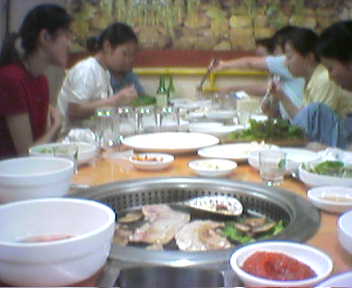
I tried to recall my memories in korea by looking at my pictures with my friends. All of a sudden, I felt like I went to eat korean food. So, I made a phone call to my sister ( studying at IPFW )and went out to eat. We went to the korean resturant ( Tokyo & Seoul) in west jefferson. Tell you the truth, that resturant is pretty expensive. I chose that resturant coz I went to eat Sam-gyab-saal. I loved to eat Sam-gyab-saal when I was in korea. I used to eat it three or four times a week.
Sam·gyab·saal
Korean meal consisting of chiefly pork, accompanied with various side dishes like bu·chim·gae, lettuce leaves, native grass and herbs, onions soaked in vinegar, roasted cocoons, fried eggs, and a hundred other things that you wouldn't even want to know. And ofcourse, So·ju ( korean beer)Tranlated literally, Sam·gyab·saal means three fold flesh. This meal is usually served at special occasions like welcome parties, farewell parties, homecoming parties, birthday parties, graduation parties, thesis defence parties, and any other goddamn reason that you can think of. Infact other than drinking beer, this is the only way that Koreans celebrate. The table is very low and everyone sits on small cushions on the floor around it. The table, typically crowded with more than fifty bowls, has a charcoal stove in the center over which the aju·ma places a metallic plate. Everyone gets a bowl filled with native grass & weed seasoned with exotic spices. The charcoal stove is used to barbecue raw slices of pork, which incidentally come in an almost never ending supply. The raw pork is cooked in its own fat. Some may say the fat is cooked in its own pork, but the claim has not been proven yet. Natives will usually use tongs and scissors, to cut the pork into smaller, more manageable pieces. They will then place the pork pieces onto small leaves, garnish it with some weeds, some cocoons, onions and god knows what! It is wildly rumoured that this small snack is delicious with exotic Korean sauces. After a complete meal consisting of pork and various side dishes, comes the main course which may consist of either rice with Korean curry or icy noodles. Non Koreans would normally die of overeating at this point, but Koreans are known to have the chromosome SamgyabsaalBachillus 3TZ which enables them to eat meat and drink beer endlessly.
The next day:
I tried to recall my memories in korea by looking at my pictures with my friends. All of a sudden, I felt like I went to eat korean food. So, I made a phone call to my sister ( studying at IPFW )and went out to eat. We went to the korean resturant ( Tokyo & Seoul) in west jefferson. Tell you the truth, that resturant is pretty expensive. I chose that resturant coz I went to eat Sam-gyab-saal. I loved to eat Sam-gyab-saal when I was in korea. I used to eat it three or four times a week.
Sam·gyab·saal
Korean meal consisting of chiefly pork, accompanied with various side dishes like bu·chim·gae, lettuce leaves, native grass and herbs, onions soaked in vinegar, roasted cocoons, fried eggs, and a hundred other things that you wouldn't even want to know. And ofcourse, So·ju ( korean beer)Tranlated literally, Sam·gyab·saal means three fold flesh. This meal is usually served at special occasions like welcome parties, farewell parties, homecoming parties, birthday parties, graduation parties, thesis defence parties, and any other goddamn reason that you can think of. Infact other than drinking beer, this is the only way that Koreans celebrate. The table is very low and everyone sits on small cushions on the floor around it. The table, typically crowded with more than fifty bowls, has a charcoal stove in the center over which the aju·ma places a metallic plate. Everyone gets a bowl filled with native grass & weed seasoned with exotic spices. The charcoal stove is used to barbecue raw slices of pork, which incidentally come in an almost never ending supply. The raw pork is cooked in its own fat. Some may say the fat is cooked in its own pork, but the claim has not been proven yet. Natives will usually use tongs and scissors, to cut the pork into smaller, more manageable pieces. They will then place the pork pieces onto small leaves, garnish it with some weeds, some cocoons, onions and god knows what! It is wildly rumoured that this small snack is delicious with exotic Korean sauces. After a complete meal consisting of pork and various side dishes, comes the main course which may consist of either rice with Korean curry or icy noodles. Non Koreans would normally die of overeating at this point, but Koreans are known to have the chromosome SamgyabsaalBachillus 3TZ which enables them to eat meat and drink beer endlessly.

2 comments:
Your blog is so much fun to read! My sister-in-law loves Korean food (and many other kinds, as well) and she took me to Toyko Seoul one time! You're right, it's definitely not cheap. I think she had a 10% off coupon, though. Anyway, I just got sweet and sour chicken, but next time I'll have to try something more festive!
Ah, if only I ate pork. Unfortunately, writers like Grandin, who we read in class, have convinced me pigs have souls. Now I get asked if I'm Jewish or Muslim all the time because I abstain.
It's strange how important context is in race. I've never thought much about the difference between Koreans, Japanese, Chinese. Here we're encouraged to refer to all of them as Asians. But I don't even know what I am. A miss-mash of Northern European. Of course it's not important because I look like most other people around here.
Post a Comment